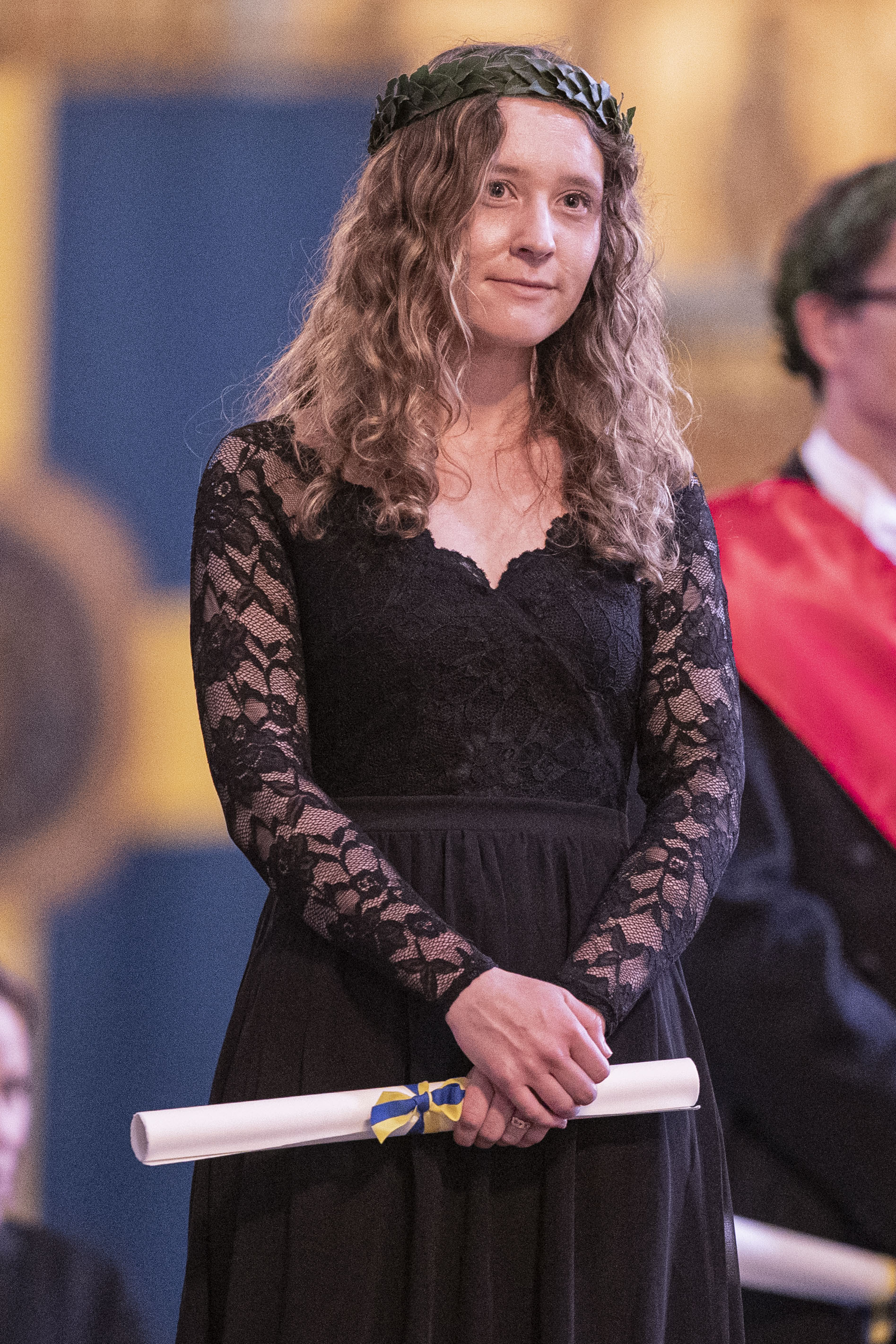
Dr. Linn Eriksson
I am an astrophysisict currently working as a research scientist at the American Museum of Natural History in New York.
My research focuses on planet formation, which I study using computer simulations.
Recent research projects include investigating how the first planets and planetesimals in the universe may have formed;
how spiral waves generated by growing giant planets influence the dust distribution in protoplanetary disks;
and how the Solar System’s ice giants might have formed.
I was born in the south of Sweden, in a tiny village called Kruseböke.
I completed my undergraduate and graduate studies at Lund University under the supervision of Prof. Anders Johansen.
During my time in Lund, I was also actively involved in student life and served as the conductor of the student orchestra Bleckhornen for 3.5 years.
After defending my PhD in May 2022, I remained in Lund as a postdoctoral researcher until the end of the year.
In early 2023, I moved to New York to begin my postdoctoral fellowship in the Institute for Advanced Computational Science at Stony Brook University.
While in New York, I was also appointed as a research associate at the American Museum of Natural History (AMNH).
Together with Prof. Mordecai-Mark Mac Low and collaborators, I was awarded a NASA Emerging Worlds grant in 2025,
which provides three years of funding for salary, travel, and research expenses.
I began working at AMNH in July 2025, which is where I am currently based.
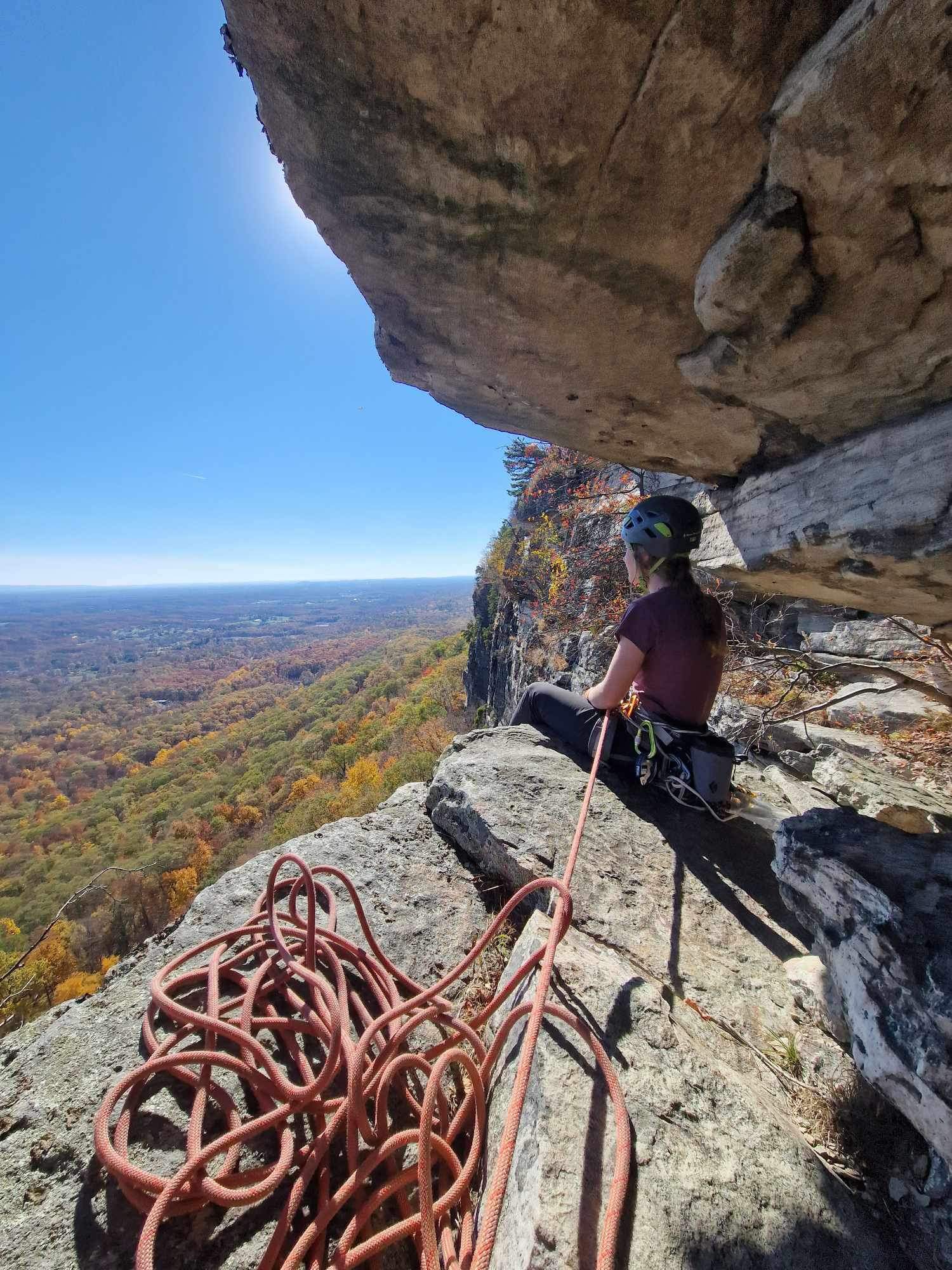
My main interest outside of research is rock climbing, and you’ll often find me at the rope climbing gym several times a week.

Research Overview & Publications
My research broadly focuses on the formation of planets, which I study using computer simulations.
My primary research interests include dust evolution in the protoplanetary disks,
planetesimal formation, planet-disk interactions and giant planet formation.
From dust to planetesimals
The planet formation process takes place in protoplanetary disks, which are thin structures surrounding newly born stars.
These disks consist mostly of gas, with a small fraction of solids that are initially in the form of ~micron-sized dust and ice grains.

The sketch above shows the gas component one the right and the dust component on the left.
The gas is threaded by a magnetic field, and the coupling of this field to the gas depends sensitively on the ionization fraction of the gas.
In most parts of the disk, the gas is only weakly ionized and therefore falls within the regime of non-ideal magnetohydrodynamics (MHD).
Dust evolution
The first step in the planet formation process is the growth from dust to pebbles, which occurs via pairwise collisions.
Collisions between dust particles lead to different outcomes depending on the collision velocity and the properties of the grains.
Collisional growth typically stops at ~mm-cm sizes, since collisions between such pebbles usually result in fragmentation.
During the growth process, particles decouple from the gas, settle toward the midplane, and radially drift toward the star.
This radial drift occurs because gas orbits at a sub-Keplerian velocity, which is slower than that of the particles.
As a result, the particles feel a headwind, lose angular momentum, and drift toward the star.
Because of these high drift velocities,
processes must exist that either trap particles and/or convert them into larger objects that no longer drift (i.e., planetesimals).
Planetesimal formation
Planetesimals, sometimes called the building blocks of planets, are ~100 km-sized objects.
The leading proposed mechanism for forming planetesimals is the streaming instability (SI).
Local particle overdensities exert drag on the gas and enhance the local gas velocity, resulting in a smaller velocity difference between gas and particles,
and thus a lower radial drift velocity for the particles.
As a result, isolated particles that drift faster catch up, leading to ever larger overdensities that drift even slower, and so on.
This is a runaway process that, once triggered, results in the formation of dense filaments that can gravitationally collapse into planetesimals.
Related research projects
My NASA Emerging Worlds grant was awarded to study planetesimal formation under realistic disk conditions
(link to NASA proposal).
In this project, we will investigate how the streaming instability operates in the disk when non-ideal MHD effects are taken into account.
In Eriksson et al. (2025),
I examined whether the first planetesimals and planets in the Universe could have formed inside vortices.
Planet-disk interactions

Growing planets launch spiral waves in the protoplanetary disk.
In the case of massive planets such as Jupiter or Saturn, the torque exerted on the disk drives gas away from the planetary orbit,
resulting in the opening of a planetary gap.
The pressure maximum that forms at the gap edge can trap drifting pebbles, making this a favorable location for planetesimal formation via the SI.
Related research projects
I investigated the formation and evolution of planetesimals formed at planetary gap edges in Eriksson et al.
(2022,
2021,
2022).
I also examined how planet-induced spiral waves affect dust evolution in
Eriksson et al. 2025.
Giant planet formation
After planetesimals have formed, they can continue to grow via the accretion of other planetesimals and/or pebbles.
If a planet forms with a mass several times that of Earth, it can also begin to accrete significant amounts of gas from the surrounding disk.
If this process occurs while there are still substantial amounts of gas in the disk, the planet can grow to become a gas giant such as Jupiter or Saturn.
If the process begins later, or if gas accretion is much slower, lower-mass giants that consist mostly of solids, such as Uranus and Neptune, form.
Related research projects
I studied the formation of Uranus and Neptune in
Eriksson et al. (2023).
I also examined whether gap-opening planets with planetesimals forming at their gap edges
can accrete significant amounts of planetesimals during their formation in
Eriksson et al. (2022)..
Link to publications: ADS Library.
Posters
- Origins of Solar Systems, Gordon Research Conference (South Hadley, 2025): Particle fragmentation inside planet-induced spiral waves
[Download pdf]
- Protostart and Planets VII (Kyoto, 2023): What’s going on inside all those rings? The saga of planetesimal formation at planetary gap edges
[Download pdf]
- From stars to planets II (Göteborg, 2019): Pebble drift and planetesimal formation in protoplanetary disks with planets
[Download pdf]
Get In Touch
Address
American Museum of Natural History
200 Central Prk W
New York, NY 10024
USA
Web: amnh.org
Email
leriksson [at] amnh [dot] org
Elements
Text
This is bold and this is strong. This is italic and this is emphasized.
This is superscript text and this is subscript text.
This is underlined and this is code: for (;;) { ... }. Finally, this is a link.
Heading Level 2
Heading Level 3
Heading Level 4
Heading Level 5
Heading Level 6
Blockquote
Fringilla nisl. Donec accumsan interdum nisi, quis tincidunt felis sagittis eget tempus euismod. Vestibulum ante ipsum primis in faucibus vestibulum. Blandit adipiscing eu felis iaculis volutpat ac adipiscing accumsan faucibus. Vestibulum ante ipsum primis in faucibus lorem ipsum dolor sit amet nullam adipiscing eu felis.
Preformatted
i = 0;

while (!deck.isInOrder()) {
    print 'Iteration ' + i;
    deck.shuffle();
    i++;
}

print 'It took ' + i + ' iterations to sort the deck.';
Lists
Unordered
- Dolor pulvinar etiam.
- Sagittis adipiscing.
- Felis enim feugiat.
Alternate
- Dolor pulvinar etiam.
- Sagittis adipiscing.
- Felis enim feugiat.
Ordered
- Dolor pulvinar etiam.
- Etiam vel felis viverra.
- Felis enim feugiat.
- Dolor pulvinar etiam.
- Etiam vel felis lorem.
- Felis enim et feugiat.
Icons
Actions
Table
Default
| Name |
Description |
Price |
| Item One |
Ante turpis integer aliquet porttitor. |
29.99 |
| Item Two |
Vis ac commodo adipiscing arcu aliquet. |
19.99 |
| Item Three |
Morbi faucibus arcu accumsan lorem. |
29.99 |
| Item Four |
Vitae integer tempus condimentum. |
19.99 |
| Item Five |
Ante turpis integer aliquet porttitor. |
29.99 |
|
100.00 |
Alternate
| Name |
Description |
Price |
| Item One |
Ante turpis integer aliquet porttitor. |
29.99 |
| Item Two |
Vis ac commodo adipiscing arcu aliquet. |
19.99 |
| Item Three |
Morbi faucibus arcu accumsan lorem. |
29.99 |
| Item Four |
Vitae integer tempus condimentum. |
19.99 |
| Item Five |
Ante turpis integer aliquet porttitor. |
29.99 |
|
100.00 |